The Pomodoro Technique
Struggling with Focus? Try this Tomato-sized Productivity Hack.




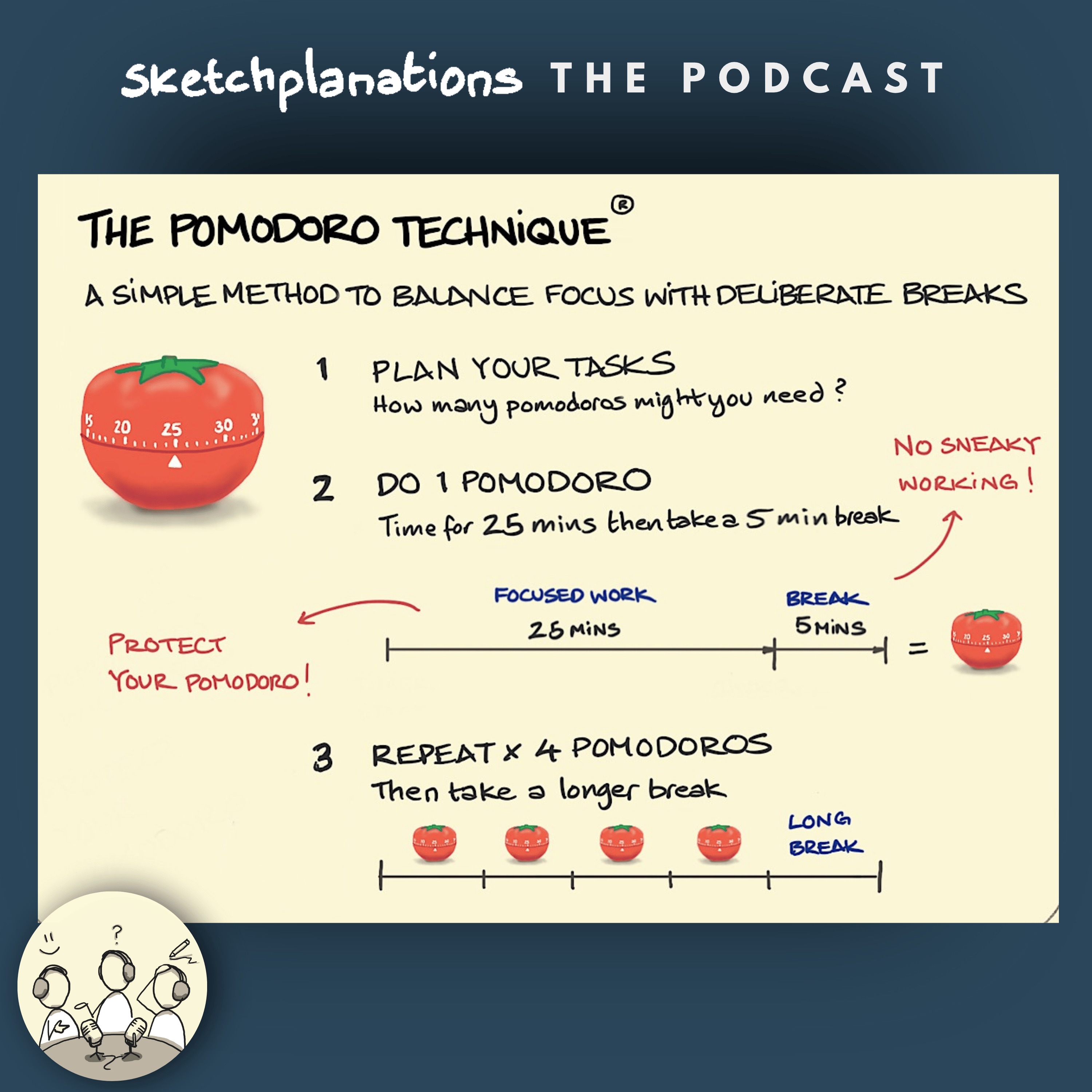
This genius time management hack was conceived by Francesco Cirillo. The technique involves working for 25 minutes followed by a mandatory 5-minute break, repeating this cycle three to four times before taking a longer break. We share our personal attempts at using the method, explore the psychology behind productive work cycles, the importance of taking breaks and reflect on its effectiveness in both office and home environments. We also discuss the broader context of productivity obsession and share insights from using related tools eg. online "focus buddies". The session concludes with a follow-up on how the Pomodoro Technique has worked for them a week after recording the episode, reenforcing a lot of the theory we originally set out.
Could this be our favourite procrastination buster yet!?!
External links
In the episode we reference a number of items you can find out more on here:
- Previous podcast episodes came up a lot (procrastination is a recurring theme for us): How to Instantly Feel Better; Yak Shaving; Goldilocks Tasks & The Fresh Start Effect
- Remarkably, there's currently no sketch for it, but Jono talks about The Red Queen Effect or Hypothesis - the concept of having to run to stay still.
- The Bear Focus Timer (used by Jono and now Tom as well). Available on Apple Store
- Examples of Focus Buddy or Accountability Partner websites include Focus Mate and Flow Club.
Episode Summary
00:00 Introduction to Sketchplanations Podcast
00:29 Exploring the Pomodoro Technique
01:03 Origins and Basics of the Pomodoro Technique
02:57 Implementing the Pomodoro Technique in the Office
07:23 Challenges and Adaptations of the Pomodoro Technique
17:10 Alternative Productivity Methods
18:53 Accountability and Shame in Productivity
19:40 Origins of the Pomodoro Technique
20:17 Applying Pomodoro in Different Environments
21:32 Psychological Benefits of Time Blocking
22:38 Challenges and Adaptations in the Office
23:01 Personal Admin and Procrastination
23:22 Flow and Creative Tasks
26:16 Post-pod Findings on Pomodoro Technique Usage
28:44 Final Thoughts and Outro
All music on this podcast series is kindly provided by the very talented Franc Cinelli.
Rob Bell:
Hello, and welcome to Sketchplanations The Podcast, a fortnightly chat amongst friends on a topic covered by sketchplanations.com that without doubt will spark your own great conversations, probably.
I'm engineer and broadcaster Rob Bell, and with me is designer and creator of Sketchplanations, Jono Hey, and entrepreneur and past winner of The Apprentice, Tom, I've just invented a new thing, Pellereau.
Hello, mes amis.
Tom Pellereau:
Hello, hello.
Jono Hey:
Hello.
Rob Bell:
This episode, we're going to be talking about a time management hack called the Pomodoro Technique.
Right then, Jono, what's the deal with this then?
And where did you hear about it?
Jono Hey:
I was taught this by somebody I worked with, partly and maybe we'll get to it because I was a bit confused about what he was doing.
And so he explained to me that what he was doing was something called the Pomodoro Technique, which was something really good as a time management technique in a way to help you get stuff done.
Rob Bell:
What was it?
In the office you were working with it?
Jono Hey:
Yeah, I'll explain in a bit because it will make more sense once we understand what it is.
So the Pomodoro Technique is a really simple method conceived by this guy, Francesco Cirillo, and it's called Pomodoro, which is the word for a tomato in Italian, and he's Italian.
And he was basically a student, as many of us have been, struggling to get stuff done and stay on task and fight procrastination.
And he was sat there in his kitchen and so he goes, okay, and he looked around, what can I do?
Get stuff done.
And then you saw this timer, which was shaped like a tomato.
And he goes, I set it going for, I think it was just two minutes first, set the timer.
Rob Bell:
It's a little analog timer, right?
That you'd find in the kitchen, something like that.
Jono Hey:
Exactly.
There is a classic Pomodoro timer, which is like a tomato in two halves that you rotate in the opposite directions.
And so the time is along the middle and it rotates back.
So anyway, he had one of these to hand and he set it going and he was like, I'm going to work until it goes off.
And he was like, that was quite handy.
It worked quite well.
And so he's tried it again.
And then he tried it with a bunch of different times.
And he basically settled on what he called the Pomodoro Technique, which is you take your timer, you set it for, let's say, 25 minutes, you do focus work for that.
Then you take a short break of about five minutes.
And that is one Pomodoro.
And then you do three to four of those and then you take a long break.
And that's it.
And it's a way to make yourself do stuff.
Rob Bell:
And for Francesco, it obviously works because he kept doing it.
Jono Hey:
Because he kept doing it and he made it a thing.
Rob Bell:
And he was doing it in the office.
Jono Hey:
Taking it.
So he was a student.
Oh, sorry.
What are you talking about?
My friend?
Rob Bell:
Yeah.
Jono Hey:
Oh, my colleague.
Okay.
Rob Bell:
Oh, your colleague wasn't Francesco.
Jono Hey:
Yeah.
Do you want to do that again?
I'm so confused.
No, my colleague was not Francesco.
No, this is a guy who was invented in like 1980s, something.
Rob Bell:
Oh, okay.
Okay.
Okay.
Okay.
Jono Hey:
Yeah.
Okay.
Well, I'll tell you.
So, the reason why I was confused and the reason why I learned what it was is because part of the Pomodoro Technique is making yourself take a break.
So, it sounds really obvious and simple, but actually sometimes we just don't do that when we're at the office.
And he was very religious about his Pomodoro Technique breaks.
And that line about no sneaky working on the sketch is actually from him.
Yes, he's like, no, you don't work in the break.
You take a full break and then you're going to work better the next thing.
And what he would do in his breaks was watch Mexican wrestling.
Rob Bell:
Sure.
Is that part of the technique or is that a bit more freestyle?
Jono Hey:
I think that's, it's up to you if you want to, if you want to build that in.
Tom Pellereau:
Was that live?
Did you have Mexican wrestlers in the office?
Jono Hey:
Fortunately, it wasn't live, but it was just a fairly small office with a visible monitor and putting your headphones on and then everybody's making sales calls and working on documents and things like that and he's out there leaning back watching Mexican wrestling.
Rob Bell:
Love it.
Jono Hey:
So naturally, it wasn't too long before someone asked, what's going on?
And that's how I learned about the Pomodoro Technique.
Rob Bell:
Brilliant, brilliant, brilliant, brilliant.
And we do talk about this kind of theme fairly often, I think, which is probably very reflective of our own challenges when it comes to sitting down and doing some work, right?
The art of procrastination and I should say the challenge of procrastinating, the challenge of getting stuff done, the challenge of focusing on a task.
I mean, we even recorded a podcast that touched on this the other week about, what was it, if you're feeling stressed, go for a walk, was that it?
Jono Hey:
Yeah, yeah, there's a few like that.
Rob Bell:
And making ourselves stop at a point and go and do something else.
So it's a very, it's very similar thieves that come up, but this is a lovely little hack, right?
This is a very simple hack that hopefully we can offer up to our listeners to try out.
Jono Hey:
Well, I was glad to cover it actually, because I mean, part of the reason why it came up as a potential one to talk about was, it's been really popular.
I mean, I wouldn't not ever say that this is one of my best sketches, but it's one of the most popular sketches over the years.
And I think that goes to show that it's not just us struggling to make ourselves do something.
Like we're, there's so many people somewhat obsessed with productivity and this challenge of making ourselves stick to tasks and do goals, which we know are good for us, but are hard to actually make ourselves do.
So yeah, it's a really popular one.
Rob Bell:
I'm going to go off on a tiny tangent here, because you've brought it up, and I think it's really interesting.
Do you sometimes wonder about our obsession with productivity that seems to be taking hold of a lot of people in this era?
And have you ever considered the alternative of kind of just being a bit more chilled about everything?
Do you know what I mean?
Jono Hey:
Yeah, absolutely.
Rob Bell:
But it's hard.
Jono Hey:
It's hard.
Rob Bell:
I find it hard.
Jono Hey:
Everybody, you feel like this, I guess you're so connected with everything else going on.
If you just stand still, you feel like you're going back.
There's something called the Red Queen Effect, which I've never sketched, which is basically like you have to run in order to stay still.
Rob Bell:
Yeah.
Jono Hey:
I think people sort of feel that, like they should begin, but what am I doing with my spare time?
Nothing.
I could be learning.
Now you can have AI agents doing work for you in the background all the time.
Rob Bell:
Is that a reflection on modern life of the last couple of decades, do you think?
I don't know.
We don't need to spend too long on this, but it is an observation that I've made about myself sometimes, because it is this obsession of keep driving, keep being productive.
Come on, keep being proactive, keep going forward.
You're like, God, it is tiring.
If I could be different, I wouldn't mind changing that a bit.
Tell me.
Tom Pellereau:
Well, time is one of the only things that no matter how rich or you are, you have no ability to control.
It's the ultimate resource, and so we try to make the most of it.
And certainly employers are always looking to try and make the most of their team.
And also, I remember someone I worked with was very, very good at leaving at sort of 5 o'clock on the dot all the time.
And he was therefore incredibly productive actually.
And I was always amazed and impressed with him.
Jono Hey:
He went to watch Mexican wrestling.
Tom Pellereau:
And that's something that we really try to encourage at our work.
We all leave, it's actually 5.30, but we all pretty much leave on time.
I do tend to stay longer personally, but then you have time to do other things in the evenings, which I think is very important.
Rob Bell:
I just have a lovely image there, Tom.
You high-fiving everyone at 5.30 as they leave the office.
I can imagine that.
Tom Pellereau:
Yeah, it's...
Jono Hey:
That's great.
Rob Bell:
Now, Tommy, when we were discussing what to pod chat about for this episode early in the week, you said that you'd be willing to try out the Pomodoro Technique in your live office environment today and report back.
So, you know, now we cross live to Tommy's office.
Tom, describe the scene and tell us, how did it go?
Tom Pellereau:
Yes, so this is a technique I have heard of before, and so I was like, I do remember trying that once, I'm sure.
I should do that this morning.
So today, I dropped the kids off early and I was in the office at 8.
I was like, right, okay, let's map these out.
And so, oh, it's quite cold in the office today.
Okay, well, I better sort out some of the heating before the other team arrive.
And then it actually became a bit of a yak shaving incident in the fact that I was like, oh, it's a bit cold.
I should just turn the heaters on.
Oh, where are the heaters?
Oh, the heaters aren't here because it's been summer.
We've not needed heaters.
So instead, we've got all these fans around the office.
So I was like, well, clearly we're not gonna need the fans anymore.
So I start moving one fan and then another fan, and these are sort of a bit quite, and then you start putting the heaters in and they're like, oh, if I'm gonna put them in, I should probably set them, and I should probably make sure they're on the right plugs and all this sort of stuff.
And all of a sudden, I've lost about 40 minutes of my first Pomodoro because I've been yak shaving.
Let's try and improve the office for everyone when they arrived.
And then I was like, no, okay.
I think it was actually about half past, like, right, fine.
Okay, half an hour till most people are in, I'll do one.
And so I got down there, I set a timer and it was going through and then actually loads of people walked in and I'm like, no, I'm in Pomodoro.
I'm not even going to look up and say hello to people.
And I did feel I was being kind of a bit rude, but I had my headphones on.
I was like, no, I'm going to keep focusing on this bit of work until my 25 minutes is up.
Rob Bell:
You set 25 minutes.
Tom Pellereau:
Yeah.
And then I got to 20 minutes and then someone came over and they needed some help from me.
And again, it turned into quite an elaborate task.
And then like 20 minutes later, I'm now way past my first Pomodoro.
I haven't had my five minute break.
I'm like, oh, it started so well and already it's been nailed.
And then there was a meeting and then another thing.
And I didn't even reset my Pomodoro timer.
So I did one, which got extended and then I failed.
So I will try again on Thursday and Friday when we have less people in the office.
But I must say, in a working environment with lots of people around, it was pretty tricky.
And if I'd known about the Mexican wrestling technique for the five minutes off, then maybe that's what I should have been doing.
Rob Bell:
Well, Tom, that's very honest.
And my first question beyond this was, was it successful?
Was it more productive?
What were the challenges about interruptions you've talked about?
All of those.
Firstly, let me point out to listeners, any listeners who don't know what yak shaving is, there is both a fantastic sketch on yak shaving and a podcast that we did about it, podcast number two, I think.
So if you fancy figuring out what that is, go back and listen to that, or at least have a good look at yak shaving on sketchplanations.com as a sketch.
But Tommy, can I ask about the 20 minutes that you said you did get with the Pomodoro when people were coming in, but you remained focused, did that feel like a really productive time because you'd set that timer and you were trying to get something done by the end of your 25 minutes, even though it ended up only being 20 minutes?
Tom Pellereau:
It was only focused.
Rob Bell:
More focused than you think you might have been without?
Tom Pellereau:
Yeah, because when people were coming in, I was like, I'm going to stay on this focus because I've got this five minute reward in some ways.
I did actually set an alarm and my intention very much was, and what I wanted to do is, can I set an alarm that would be 25, then five, then 25, then five?
And I was sort of, oh, no, I don't know how to do that on my phone.
I'll just have to do it separately or individually.
And I was focused.
During that period, they're always sort of checking emails, which is how I tend to start the morning.
So I don't think that's probably the best task to be doing.
Rob Bell:
This is all like productive, right?
Learning what works and what doesn't work for you with Pomodoro Technique.
So maybe then on Thursday or Friday, as you say, when it's less busy in the office, to try it again at a time of day where it might suit you.
Because I don't think we're suggesting that you Pomodoro right through the day, right?
From 9 till 5 or 5.30 in your case, Tommy.
Pick a point in the day, I think is probably the suggestion for an hour, an hour and a half, two hours maybe, and try and Pomodoro through that.
Tom Pellereau:
Yeah, I think it's a great concept when you've got something to do, a specific task.
I'm really intrigued to talk to my kids about it.
I think they might find it quite useful way of doing work.
There's 25 minutes stretch and then they get say five minutes on the iPad or maybe we might do 20 and 10 or 25 and 10 or something like that.
I think that could work really nicely.
I do like the aspect of the very analog using an egg timer, although I hate the noise of tick, which I wish a lot of those do.
I would feel like I'm on some kind of countdown version that need to be sprinting through.
Rob Bell:
What was your timer?
Was it an app?
Was it just on the phone?
Tom Pellereau:
Yeah, it was just on the phone, which I didn't have as well, and then it goes off.
Of course, it went off in the middle of this conversation.
I was having one with Scalight, so I had to turn it off.
Rob Bell:
I was hoping you were going to say it was like some kind of robot timer or something like that, Tommy.
I can imagine you with one of those on your desk.
I don't know, like a penguin or something like that.
Tom Pellereau:
I hope it's just with me to get one of those egg timers.
You know the ones with the sand going through, I wonder if you can get 25-minute ones of those, which is nice and quiet and very analog.
Although it doesn't do the five, we did another one.
Rob Bell:
Yeah.
Then you've got a whole line of egg timers.
A mutual friend of all of us actually used to do this.
I don't know if he's doing it again at the moment.
He used to use this app.
It was called something like the Wolf Timer or something.
The thing was that it howls like a wolf when your time period's up.
It shocks you out of it.
Oh my gosh, right.
Okay.
Yeah, that's done.
I quite like the idea of that.
Jono Hey:
I actually mentioned in the detail under the sketch, there's a really nice app I like for it.
It's called Bear Focus Timer.
It was not a wolf, but it made me think of that.
It's a really cute little app actually.
It's a big picture of a bear.
You can configure it so it doesn't have to be 25 minutes.
It could be three repeats, four repeats.
It could be five-minute break, 10-minute break, whatever you fancy.
If you're doing it with something for your kids, maybe you could do 10 minutes, three minutes or something.
The way it works is that you set that up, you press go, and the timer only starts when you turn your phone down, face down on the desk.
Rob Bell:
Oh, that's good.
Jono Hey:
And then it can also play some sound like it plays white noise or rain, which I think is quite nice.
And you can't look at your phone because if you turn your phone over, it stops and it complains at you.
So it's a nice way of locking out the phone and putting the sound on to mark the period.
And then it does a little birdcheep at the end.
It's a really nice one.
You've done a good job with it.
Rob Bell:
I tried it with a regular timer app that was just in big digital digits on an old phone.
So I used to pop that on the corner of the desk so you could kind of keep an eye on the countdown and see where you were.
But more than anything else, it was really good for pointing out just how much I can underestimate how long a particular task at the desk will take.
I think that was my main takeaway from it.
You're like, just add another 10 minutes on that.
Okay, let's go again.
Jono Hey:
You're banging the middle of something when it hit the brakes.
So did you take the brakes?
Rob Bell:
No, I wasn't intending to take a break because it was pre-Pomodoro Technique Podcast Chat.
So now I know how to take a break.
But you bring up a really good point, Jono.
The brake is the really important part of this, I think probably more than anything else.
Jono Hey:
Possibly.
And so I think it is quite interesting.
Apparently, Francesco experimented.
And by all means, you could set the time for whatever you want works for you.
But there's something about that region around 25 minutes where it's enough time to get into a task and really get going on it.
But hopefully not enough that you start to lose focus and get bored of it and go, I'm going to do something else now.
And so in a way, you should be properly in it around 25 minutes.
And then, yeah, I think the brakes are really interesting because in one way, it's quite nice to have permission to take a break.
One of the things I like about the technique is it goes, right, five minutes, no work, please.
And I'm like, okay, good.
I'm going to go make a cup of coffee or go stretch or walk outside or say hello to somebody.
And you might not otherwise do that.
I probably just like crack on until I'm not actually getting anything useful done.
So yeah, it's an interesting question as to whether or not the brakes are part of your productivity, which I think they are.
Rob Bell:
I think they are.
I think they are.
And I think you need to, if you're going to try it out, I think you need to try and be as regimented as possible with it.
So doing the 25 minutes.
And I would say when I try this out, I will get up from my desk for five minutes.
I will move my body.
I'll loosen my joints.
I'll get the blood flowing back into limbs and be really strict about that.
But I'll also be really strict about when my five minutes is up.
I'm not going back to the desk.
I want to be at the desk when five minutes is up and go.
Otherwise, I know what I'm like.
You know, the coffee turns into a coffee and a couple of biscuits.
And I'll just watch this quick thing on YouTube and it's ten minutes.
Oh, that's okay.
And then I'll get to it.
So if I'm going to do it, I want to be really regimented with my 25 minutes, let's say, and my five minutes and try and get into a cycle of that.
Jono Hey:
Yeah, it's good.
It's a bit like it reminded me of like kids and break times at school, you know, and they go run around like crazy.
And as a result, they probably work much better in the classroom when they come back.
So I think we probably all could do a bit more of that.
Like we're not machines that just keep going nine to five, boom.
Rob Bell:
Good, similarly.
Jono, I've talked about the difficulty that I have with getting started on projects, definitely on the podcast before, and I was discussing it with, discussing a particular project with my coach who I'm working with at the moment.
It was about a couple of months ago.
And she suggested something that I'd not heard of before, which was using what's called a Focus Buddy or Accountability Partner app or website.
So examples of these kinds of websites, one's called Focus Mate, there's another one called Flow Club.
Basically, you just go on there, there's not much registration, and you pop into the calendar and say, right, at 10.30 this morning, I want to do 50 minutes of solid work.
And it would be great if I could find a partner to come on and do 50 minutes with me.
And then invariably, because it's global, there are people working all over.
They go, oh, yeah, I'll do that.
That works for me.
Whatever 10.30 is for their time, whatever they are in the world.
So you go on, you meet, you say, hi, I'm Rob.
And you say very quickly what you're going to do in the next agreed period, 50 minutes.
And then you ask your buddy to say the same, what are you working on today?
Like, OK, yeah, great.
And then you can keep them on the screen if you like, or you can close down your camera or whatever.
And at the end of the session, the end of the 50 minutes, you check back in very quickly, you go, hey, how did you get on?
And they tell you how you got on.
And then you do the same.
And then you say, cheerio.
And it was really, really good.
It worked for me for that particular project that I just couldn't get started on as a writing project.
I just couldn't get started on it.
Jono Hey:
So it's without names, like, who did you get?
Rob Bell:
There was a guy in the US, there was a guy in London, and there was someone in Singapore.
I did it three times within two days.
Jono Hey:
That's so fascinating, isn't it?
Rob Bell:
Have you heard of anything like that?
Tom Pellereau:
No, that's nuts.
Rob Bell:
Yeah, it's nuts, isn't it?
It's nuts.
Tom Pellereau:
The human psyche is fascinating, isn't it?
Rob Bell:
Because suddenly you're accountable to that person.
You've just said to them, in the next 50 minutes, I'm going to do this and this.
Tom Pellereau:
Never met them before.
Rob Bell:
One guy, so I was doing desk stuff, and the other two were doing desk stuff.
One guy just had, yeah, I just need to tidy up my flat or my apartment for the next 50 minutes, and I just need to tidy stuff up and put things around.
There he was, he left his camera when he was just moving around.
Not that I was watching because I was doing my own work.
Yeah.
You're just telling your brain, just focus on this for now.
If you've told somebody else that that's what you're going to do, I've found it, it helped make me accountable.
Jono Hey:
So even though they were like essentially a complete stranger, you'd feel ashamed if you hadn't got through your task.
Rob Bell:
Call it shame.
Yeah, sure.
Jono Hey:
I don't know, that's the word that came to mind.
You didn't want to disappoint them.
Rob Bell:
You know, the shameful life I lived, Jono.
So yeah, shame.
Tom Pellereau:
That was good.
I would love to know the guy who came up with this technique, what he was actually supposed to be working on when he came up with this technique instead of working on what he was supposed to do.
Jono Hey:
Yeah, this is a classic.
This is a classic Tom thing to do.
Oh, I'm supposed to be revising for my exams, but I could come up with a really good productivity technique.
Tom Pellereau:
I hope so many people.
Jono Hey:
He spent days, he wrote up the method, he did a little video of it.
Tom Pellereau:
Little pictures.
Jono Hey:
He failed his exam.
Tom Pellereau:
He tried different amounts of time.
Jono Hey:
Yeah, scientific methods, jotting stuff down.
But it was a gift to the rest of us, Tom.
Tom Pellereau:
Yeah, exactly.
Jono Hey:
Interesting you tried it in the office, Tom, because I think that is good.
Because actually, I was thinking when he came up with it, he was at home in the kitchen, because that's why he had the timer around, and he was by himself, and he was trying to do this long task, like revising for exams, which is so different from an office environment.
A lot of people might be working from home, and you've got a big thing, you've got it right this afternoon.
But that's not every day by any means, and especially if you're in office, like you're in the middle of a Pomodoro, and then somebody comes and asks you a question, and are you going to educate them?
I'll speak to you in 15 minutes.
I'm in the middle of a Pomodoro.
Tom Pellereau:
I actually can't, because that's on my break.
Jono Hey:
Five minutes.
Oh, yeah, that's work.
Rob Bell:
But if you see a tomato on my desk, you stay away.
Oh, no, not on Tuesday.
That's different.
That was my lunch.
Jono Hey:
Yeah, so it works really well at home, I think, when you've got your own thing.
And also, like you mentioned about doing e-mails, it's like, I don't know if you probably don't need a Pomodoro Technique to make yourself do some e-mail work, but like doing things, you keep putting off, you keep procrastinating the bigger projects, which are harder to get started, or you keep knowing that you're not starting on it and you should start on it.
I find it quite useful when I want to get stuck into that.
Rob Bell:
I think there's some fairly solid psychology behind the theory of this kind of time blocking or working in short sprints as well.
I mean, for one, I could certainly see how it would allow my brain to turn off the kind of panic and anxiety you might have about all the other tasks that you need to do that one day, because you have just allotted this small amount of time to get this one thing done or maybe a couple of Pomodoro's time to get it done thinking, great, I've thought about it, that's what I need, and then I'll get on to the other stuff later.
It feels more organized.
It feels like I would be allowing myself to do that.
But without this kind of technique, I know that all of those things are just swirling around in your head.
Again, you're telling your brain, right, just focus on this for now.
It kind of lowers decision fatigue and the multitasking costs that you might have instead of constantly choosing, oh, what am I going to do next?
You've done it.
Your mental bandwidth is reserved for that task at the moment.
And as we've talked about as well, the kind of reward, once it's over, I get this reward at the end, which is the break.
So I think psychologically, there's some good theory behind this as well.
Tom Pellereau:
Yeah, for a specific task, I would agree, I'm not convinced it works in the office when you've got a number of people coming in and out, that sort of stuff.
No.
But if, so for later in the week, when there's specific tasks I need to do, I will focus them.
25 minutes is a good amount of time.
At the beginning, I was like, 25 minutes is nothing.
Why, what am I going to get?
But actually, if you're doing one task, 25 minutes, then a break is probably a really good plan.
Maybe also for like personal admin, you know, sometimes it kind of really builds up.
I must check my, I've got the right insurance.
I must check I've got, you know, when you come back from work and you know you've got personal admin, you need to sort out at some point and you keep putting it off.
Maybe that's quite a good Pomodoro exercise as well.
Jono Hey:
Yeah, and things you put off.
I use it for things that I'm struggling to get into, things that I know I should do.
And I was thinking I was linking it back to Flow, which we've talked about a few times as well.
Rob Bell:
I think we talked about that on the Goldilocks Tasks podcast, we definitely came up then.
Jono Hey:
Right, yeah, and about having your focus all on one thing.
And Flow, some of the symptoms are like you lose track of time and your loss of ego because you're fully embedded in the task, and also you have a clear target and you see you're making progress.
And I think you kind of do just by going through these 25-minute periods.
You're like, I know I'm going to get from here to there.
Climbing is the prototypical Flow activity.
It's like each 25 minutes is climbing from here to there.
I'm just going to get from here to there.
I watch that timer go down and I know I'm making progress.
I was also thinking about fresh starts as well.
Like there's something nice about, I don't know, if you get to the end, for me anyway, if I start to lose a bit of focus towards the end of the 25 minutes and then I have a break, five minutes go off and do something and I come back and it's like a nice fresh start again.
Right.
Okay.
Let's do this properly.
And it sort of breaks up that what might be an endless afternoon not getting much done into lots of fresh starts, focused work.
Tom Pellereau:
It's quite good.
Rob Bell:
Yeah.
Nice.
I think with something like the creative flow that you're talking about, Jono, I'm not sure how applicable this would be in some bits of work and you do really get into that flow.
I want to ride that wave for a long period of time and I personally, I'm not sure how appropriate that would be for me or how effective I should say that would be for me for more of a creative flow task if that was writing or if it is editing or whatever it might be that's on the creative side of things.
Tom Pellereau:
So you would worry if you were to stop, you would be able to start again?
Rob Bell:
Yeah, because I find that it can take a while to get into that flow.
Jono, for instance, if you're writing music and things have just started to happen for you and then the old Pomodoro, the tomato, explodes in the corner and I've got to get up and walk around for five minutes, but I might forget what that tune was in my head.
Jono Hey:
I mean, I think if you're literally about to forget a tune in your head, then fine.
I mean, I think you should try it because I think in most of my experience when I'm doing it and even if it's been a creative task, it might feel like I'm sort of dragging myself away from being right in the zone and yet, actually it's not very long, goes very quickly.
If you go to the toilet and get a drink and come back to your desk and your brain is usually so embedded in the task that for me at least, I'm still kind of working on it and I come back in five minutes as I'm not far enough away to lose focus on the task.
I can pick up where I am and often I see things a bit fresh.
So I think you should try it.
I mean, I'm not saying it's the be all and end all of getting stuff done, but I think the five minute break even in a creative task is perhaps not as bad as you might think it would be.
Tom Pellereau:
Yeah, okay.
I've got to say, this is a great opportunity in the fact that we're recording again in two weeks or a week or so for us to try and do this.
Rob, it seems like Jono does this occasionally anyway, for us to try and do it in a number of different scenarios.
Yeah.
And see how it goes in different things.
As I say, there's always a good reason to not try something.
And there's always edge cases as to why that's something.
It's a good idea not to try it in those circumstances.
But I'm always up for trying different things.
So if I can remember, I will do this as often as I can over the next how many days till we next record.
Rob Bell:
It's going to be an absolute rush on tomato egg timers.
Tom Pellereau:
Yeah, well, I've just downloaded Jono's app that he's just talked about.
Jono Hey:
Oh, hang on.
Tom Pellereau:
What are you doing there?
Rob Bell:
Hang on.
That's the old alarm there.
Let's turn that off.
All right, guys, I'm enforcing a 90 second break.
Get up from your desks.
Do what you need to do.
Tom Pellereau:
Are you saying that we've actually been working?
Jono Hey:
I've gone.
Sorry.
Rob Bell:
You made that tip.
Sorry.
I'm off.
Jono Hey:
I'm not sure.
We're wrestling on.
Tom Pellereau:
I mean, it's anyone that we've been working.
Last 25 minutes.
Have you got anywhere to go?
Jono Hey:
Yeah, I think you're serious, Tom.
Rob Bell:
90 seconds is probably quite a bit longer than we really imagine.
So I can see Jono is stretching.
Jono Hey:
That's good.
Rob Bell:
The kettle here, I'll make myself a cup of tea.
We do have some stretches to do, actually.
Physio's done.
I did say part of the rest is making sure that after your rest period is finished, you are ready to go immediately straight away.
And I'm going to count us down in three, two, one.
Back in the room.
Jono Hey:
I thought we'd lost him.
He's got a snack.
Tom Pellereau:
Sounds quite a snack.
Cool.
Jono Hey:
So, what are you doing on break?
Rob Bell:
That's good.
I feel energized.
I feel great.
Jono Hey:
It's nice.
It's nice just getting up, having a straight.
Rob Bell:
I was chatting to my physio about this as well this week, talking about being at the desk, sat down for two hours.
I was like, yeah, no, no, but I've got my screen up high and I use a separate keyboard there for my laptop.
So, you know, it's all good.
Yeah, but she goes, how long do you work for?
I was having that sometimes, like two hours.
I mean, yeah, no, you got to get up.
You got to move at least every 45 minutes.
Jono Hey:
When you say two hours, two, three hours.
Rob Bell:
Yeah, probably two, three hours.
Yeah, because we all lie to our physios.
Yes, I've done the exercises.
Jono Hey:
It's like flossing or something, isn't it?
Rob Bell:
I mean, that is pretty much our time.
But before we sign off on the Pomodoro Technique, what else would anyone like to raise that we've not touched on yet?
Jono Hey:
I'll raise one thing, which is that it's called the Pomodoro Technique and it's got this image of this tomato timer.
And I just think in terms of like branding, a productivity technique, the reason why I stick it, it's like a great name and a great image.
If I called it like the 25 minute, 325 technique or something, it would have been so boring and relegated to the end of some productivity book.
But it's called the Pomodoro Technique.
It's got a massive tomato timer.
And I just think that's so clever.
Rob Bell:
No, it's very good.
And I was thinking about the other shapes that egg timers or cooking timers tend to come in.
Cupcakes is one, could be like the Cupcake Challenge.
Or I don't know, what else have you got?
I mentioned penguins earlier.
I've seen one of those.
Jono Hey:
We've got an owl that turns its head all the full way around.
That's good.
Rob Bell:
That makes sense.
The owl operation.
Operation Owl.
Jono Hey:
That's good.
Yeah, that could be a productivity technique.
Rob Bell:
That could work.
The Penguin Practice.
I just love alliteration.
Tom Pellereau:
You see, this is what the guy was doing for his 20 minutes.
25 minutes.
Jono Hey:
He should have been revising.
Tom Pellereau:
He should have been doing his maths homework for whatever he's supposed to be doing.
He's coming out with names.
He went through hundreds of different names.
Jono Hey:
I can't believe I did it.
Tom Pellereau:
He'll be genius.
And I bet he didn't actually have a Pomodoro one, but the one he has now, I can't name it that.
Like Chicken Timer doesn't work.
Anyway.
Rob Bell:
Anyway.
Tom Pellereau:
I'll try it out some more.
I'll let you know.
Rob Bell:
Yeah, I'll try it.
Yeah.
Let's see how we go.
Listeners, try it out.
Let us know how it goes.
Tom Pellereau:
And where do I send my letter to?
Rob Bell:
Well, you can send your emails, Tommy, to hello at sketchplanations.com.
Thank you very much.
A little while after recording the podcast, we all thought it would be a good idea if we checked back in having used the Pomodoro Technique a little more than we had, at least immediately running up to recording the podcast.
And so, well, we've got Jono and I online.
In fact, Jono, should we go to Tommy's?
I was going to say live.
It's not a live report.
But should we go to Tommy's recorded report out in action having just Pomodoroed?
Jono Hey:
Let's hear from Tom.
Tom Pellereau:
Good morning all.
I've just done a Pododo Pomodoro, using the app Jono recommended, The Bear One.
Done the 25 minutes, now having a nice little walk around before going back to the same little exercise.
So yeah, Robbie, seriously consider it.
It's my first that I've done since the podcast though, because yesterday was carnage.
Cool.
I'll enjoy the rest of my five-minute little break and a wander around, which is always quite something.
Rob Bell:
As always, Tommy not taking into account at all the sound quality of recordings, but we got the gist, we got the point.
It sounds like it was much more successful than what he'd experienced the day we recorded the podcast Jono.
Jono Hey:
A strong start and it's nice that he's enjoying his walk around.
Rob Bell:
So in the podcast, we talked about the importance of the break.
And Tommy has really taken that to heart by getting out of the office and going for a walk.
Can't think of a better way to make that break much more stark than getting out of that work environment into a completely different environment outside.
Jono Hey:
Yeah, that's good.
And my main question is, will he get back in time for the end of the break?
But when he does, he'll be raring to go, no doubt.
Rob Bell:
Right, that's good.
That's good.
All right, Jono, let's come to you.
You had used the Pomodoro Technique, obviously.
You did a sketch on it a fair bit over the years, but maybe not immediately before we record it.
Jono Hey:
No, I had been using it, but I have done some more extensive use in the period since.
Rob Bell:
And what are your takeaways from using it more extensively?
Jono Hey:
The primary takeaway is it is a good thing.
It is a good thing.
But there is some interesting facets for me, I thought.
So my typically had it set up as a 25-minute activity, five-minute break, 25-minute activity, five-minute break, 25-minute activity, longer break.
I really realized that it is very rare that I would get through the full one and a half hours without some significant interruption or having to go somewhere or something else coming up that would just interrupt the Pomodoro.
All that said, it did help me stay on task.
And whenever I did it, I have always made really good progress.
And so, if something came up, that's fine.
Maybe it came up an hour, an hour and 20 in.
I had done an hour and an hour and 20 focused work.
It was great.
It was just undoubtedly excellent at getting me started.
If I choose to sit down and start a Pomodoro, then I'm going to have a good morning or afternoon's work.
Even if I don't get through the whole thing, I'm going to look back on that and go, oh, that was a good productive session.
Rob Bell:
Good.
That's very positive.
Tom Pellereau:
Yeah.
Jono Hey:
So that was mine.
How was yours, Rob?
Rob Bell:
Also very, very positive, Jono.
And part of why I feel so positive about it is because in itself, I felt like I'd achieved something I was setting out to do by doing 25 minutes, five minutes, 25 minutes, five minutes.
So I attempted one, as you said, three rounds, which would be an hour and a half before you then take a long break.
And then I attempted two, one hours, double rounds.
What I found with the three sessions, so up to 90 minutes was in that second break, I didn't allow myself away from the project that I was working on.
Physically, I took myself away, but my brain was still very much on it.
Whereas in the first break that I took, I let myself go and I probably went and made myself a cup of tea.
But then the second break, I took myself away from my office and went and walked around and moved around, but I was still thinking about the work that I was doing for the majority of that time.
And I was very conscious of that.
I was definitely breaking down problems in my mind, but away from that work environment.
And I found that really, really helpful.
So then when I did sit back down after admittedly more like six and a half minutes, I had lots to do.
I had lots of bullet point notes to take down from that period of rest thinking.
Jono Hey:
Yeah, it's interesting that isn't it?
It's kind of the whole like you have your best ideas when you're lying in bed or you're in the shower, because you've, but only if you've been sort of actually immersing yourself in a task the day or night before.
And then your mind is a bit sort of free to to wonder on things and actually it's still churning away, still working on it.
It also made me realise just the power of timers in general.
I remember thinking like nurses use them a lot and when we give blood like in washing your hands or washing an area on the skin, they always have like a little timer clipped to them.
And so you press the timer and you do it until the timer beeps.
And it's just so helpful to keep us on task and toothbrushes going for two minutes, probably transformed how people actually look after their teeth.
Simple thing of a timer.
So maybe we should just use timers more.
It's good.
Rob Bell:
Nice one Jono, thanks very much for reporting in.
And yeah, listeners, we hope there's something useful in there for you too.
Jono Hey:
Cool.
Rob Bell:
Thank you Jono, thank you Tommy.
That's all we have time for in this episode.
And we'll be back in another two weeks with another discussion on a different sketch from sketchplanations.com.
And if you've enjoyed this episode, please do look through the back catalogue of sketches and podcasts and please do tell your family, friends and colleagues about them as well.
After all, that's what we've set out to do on the podcast to give you fodder for fun conversations with others.
In the meantime, we've still got another 18 seconds, actually, before the Pomodoro Timer goes again to find a really clever and funny outro for this episode.
So, got it out, hasn't it?
Have you got anything?
Tom Pellereau:
We're just counting down the last five seconds.
Rob Bell:
Oh God, we might have to.
Jono Hey:
I feel like it should be tomato themed.
Rob Bell:
All right, it's the old faithful then.
Go well, stay well.
Goodbye.
Jono Hey:
Yeah, bye.
Rob Bell:
All music on this podcast series is provided by the very talented Franc Cinelli.
And you can find many more tracks at franccinelli.com.