Submarine Lessons for Business Leadership
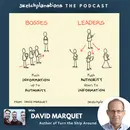
Pushing Authority to Information: A Chat with Capt. David Marquet

 Apple Podcasts
 Spotify
 YouTube
 US Navy submarine captain and author David Marquet discusses leadership lessons from turning the USS Santa Fe from worst to best, focusing on “pushing authority to information” rather than pushing information up a hierarchy. Marquet critiques industrial-age leadership language that seeks obedience and creates “bobblehead” agreement, arguing that real engagement comes from giving people decision-making authority,
He also explains “distancing,” as a leadership and decision-making tool: viewing oneself from a third-person, from a different time, and/or from a different place to reduce ego and defensiveness over previous decisions.
A thoroughly fascinating chat with a very talented and fun individual.
External Links for items referenced in the conversation:
- David’s 3 books can be found here: Turn the Ship Around (+ workbook), Leadership is Language, and Distancing
- Here are two of many of David's talks to be found on YouTube: What is leadership? and Turn the Ship Around at the World Web Forum
- Here's the YouTube video of David rating submarine movies for how realistic they portray life under the waves.
- David talks about advice given to him by Simon Sinek
- Some of Jono's other sketches referenced in this podcast include: Solvitor Ambulando (it is solved by walking); 9 windows (problem solving tool); Anchors and Tugboats (self-talk)
- David talks about ultra-runner extraordinaire Courtney Dauwalter
Summary
00:00 From Cold War Kid to Submariner
03:02 Life Aboard a High-Performing Sub
03:53 The Arbitrary Officer Divide
04:40 Student Not "Expert"
05:51 Words That Kill Curiosity
08:44 What Leadership Was Taught
12:37 Pushing Authority to Information
16:03 Submarine Leave Approval Hack
20:02 Authority in Everyday Workplaces
21:59 Bias for Action and Excellence
22:46 Distancing to Decide Better
25:41 Put Them In Your Chair
26:12 Distancing In Space & Time
27:45 Inviting Feedback Culture
28:52 Nine Windows Thinking Tool
30:25 You Can Do It Self Talk
32:28 Regret Proof Decisions
38:04 Journaling Into A Book
39:41 Be Your Own Coach
45:50 Team Reviews Without Defensiveness
47:19 Live Big Bold Lives
48:14 Submarine Movies And Ambiguity
50:55 Wrap Up
Hosted on Acast. See acast.com/privacy for more information.
Rob Bell:
Hello, and welcome to Sketchplanations The Podcast.
Chats about facts and big ideas inspired by the collection of sketches at sketchplanations.com to help fuel your own great conversations.
I'm engineer and broadcaster Rob Bell, and joining me as always is designer and creator of Sketchplanations Jono Hey, and we're over the moon to introduce our special guest on this episode, the renowned business leadership expert, best-selling author, and sought-after public speaker, Captain David Marquet.
I address him as Captain because David cut his teeth in the US Navy Submarine Force, no less.
His transformative leadership style turned the Navy's worst-performing sub into its best ever-performing sub.
David, we can't wait to talk all about that with you.
Thank you so much for joining us on the show today.
David Marquet:
Thanks for having me on the show.
It's great to be here.
Rob Bell:
Where are you normally based, David?
Because you're passing through London at the moment.
David Marquet:
Nice, France.
Rob Bell:
Oh, my gosh.
David Marquet:
Yeah, yeah, yeah.
Beautiful.
Yeah, we moved there recently.
We're going to spend like a year there, and we're a little bit ambulatory at the time.
Rob Bell:
First up, David, and it is a genuine question.
I've been calling you David, but how should I address you?
David Marquet:
That's fine.
Rob Bell:
David, not Captain.
David Marquet:
No, I mean, you said Captain once.
It's good enough.
Rob Bell:
It's been acknowledged.
David Marquet:
I'd say that for my wife.
Jono Hey:
I've got to say, I did think that I probably ought to shave a bit more this morning and sit up straight.
David Marquet:
Oh my gosh, you guys are killing me.
Jono Hey:
Get on that outfit.
Rob Bell:
Well, before we go any further, David, and Jono will no doubt roll his eyes at this, but it's only fair that you know that I've also served my time on a British Navy nuclear sub as well.
Admittedly, in the role as a TV presenter, and only for four days a night, but it was an incredible experience.
David Marquet:
Yeah.
Oh, that's great.
Yeah.
That's hard because we're very kind of reticent, quiet people.
When I grew up, we were in the midst of the Cold War, and I really felt passionately about the freedoms of liberal democracy.
Instead of being a scientist like my dad, I was supposed to be.
I was like this geeky kid on the math team, very awkward and introverted.
I remembered numbers, not your name, but I can remember your phone number.
So I went home and said, I want to do something about this, and I want to do my part, and my mom was concerned.
Said I was going to the military.
I said, no, it's okay.
There's these things called submarines.
The whole job is to hide from people, and so we call ourselves the Silence Service, and that was a good fit for me.
Rob Bell:
It is odd when you understand about the submarines that are in our oceans all the time, just trying to not be found, and then other subs trying to find those trying to not be found.
David Marquet:
Exactly.
Rob Bell:
It's an odd game of cat and mouse.
David Marquet:
Yeah, it's a nice game theory game.
Yeah.
It's like this underwater 3D chess thing.
I liked it.
There's a lot of sort of sitting and thinking and put pattern recognition.
They have to operate the submarine and do that properly, and then think about what's the enemy doing, what's the enemy want me to think that he's doing.
It turned out to be a good fit for me.
Rob Bell:
It is amazing.
When I was down, I was overwhelmed, I was impressed.
I was left with just this impression of how highly skilled and competent everybody on board that sub was.
We were down when they were getting put through their paces before actually going out on board.
David Marquet:
Yeah, that's a key time.
Rob Bell:
So there were drills being put left, right, and center.
I got to go into the room where the heads would all then deal with that crisis.
I've never seen Leadership like it.
It was like this beautifully handcrafted, manufactured Swiss watch, all the pieces just working immaculately together.
David Marquet:
It's so much fun to be on a team like that.
You got access, you were able to talk to the sailors all the way from the most junior newest sailor on board up to the captain.
Rob Bell:
Yeah.
David Marquet:
They're so impressive.
We have this system where if you went to college, you get to be an officer, and if you didn't go to college, we make you an enlisted person.
But it's kind of an arbitrary delineation.
I think it's sort of a legacy of the industrial rebel, the class system from the industrial rebel.
I mean, you need to have some kind of hierarchy, but it's kind of a stark dividing line, and it's pretty arbitrary.
It's not based on intelligence.
It's not based on drive.
It's not based on grit.
It's not based on tenacity.
It's just based on, did you go to college?
Rob Bell:
Yeah, which in itself could be a reflection of the opportunities you've had in life.
David Marquet:
Exactly.
It has nothing to do with you most likely.
Well, you'd think it does, but to surround is matter.
Yeah, of course.
Who your parents were and that kind of.
Rob Bell:
We referred to in the introduction that you are now a business leader, a business leadership expert.
David Marquet:
But I need to correct your intro.
I don't say expert.
Rob Bell:
Go on.
David Marquet:
I say I'm a student because all these little words matter.
I was talking with Simon Sinek one day.
He was looking at my bio.
We were doing, we were keynoting together on the thing.
We were good friends and he's like, yeah, you should.
We were talking about being learners, like lifelong learners and curiosity and how important that was.
It was important for my journey.
Basically, I was an engineer and numbers guy.
Now, I'm a story and word guy.
Maybe the next phase of my life, I'll be a pictures like Jono, but I don't think I'm ever going to get there.
In any event, he's looking at my bio and I was like, what do you see?
He's like, so you say right here, expert, I didn't even write it, but I didn't even notice.
Expert, we all say that, expert or whatever, and he said, it's changed the student of leadership.
I was like, that's genius.
So he changed the student of leadership 15 years ago, and my speech bureau still has this old copy, and everyone was like, well, they sent it, and I'm about to go on stage.
Expert of leadership, I'm like, no.
Rob Bell:
It's a really good point.
It's a really good point.
That nuance.
David Marquet:
I really take people's words literally, and it gets me in trouble.
It's like here in the UK, people like to say, are you all right?
You all right?
You all right?
It's binary for one thing, so I have to decide, well, I'm really not 100 percent right.
I don't think any of us are, but I'm basically okay.
Rob Bell:
Where's the threshold?
David Marquet:
Where's the threshold?
You're making me choose.
I go through this whole process thing of like, what?
I guess the answer is just, yeah, I'm fine.
Rob Bell:
That's what everybody's expecting.
David Marquet:
Yeah.
Well, actually, I woke up this morning and it's like, no one wants that.
There's another tick in language.
People like to say, right?
So we good, right?
So we're going to turn left, right?
So we're going to launch the product, right?
So we're going to, and it just, that drives me up a wall because the picture is, I don't know if you guys have them over here, but we have in the States, we have these like bobble heads that people put in their cars, like those little six inch figures and the heads on a little sprint.
I just imagine like a whole team of really smart people, and the boss says, so we're going to launch 737 Max, right?
And they like to put a bunch of bobble heads.
It's not about inviting and curiosity and descent.
What you want to say is something like, wrong?
How could this be wrong?
Rob Bell:
Yeah.
David Marquet:
How am I wrong?
What am I missing?
Rob Bell:
Yeah.
David Marquet:
But we say right because from the industrial age, we weren't interested in that.
We hired people for their hands, hence all hands meetings, and we want them to do what they're told.
That's the objective of leadership.
That's inherited from the industrial revolution.
Rob Bell:
That's interesting.
Jono Hey:
The bubble head images is a really good one.
David Marquet:
It just goes in my head.
I can't stop it.
You can do a sketch on that.
Jono Hey:
Yeah.
That would be quite a cool visual.
I think people want to introduce experts, don't they?
I suppose that's part of the thing.
David Marquet:
Well, yeah, maybe that's it.
Yeah.
I don't know.
Rob Bell:
Who wants to listen to a student?
David Marquet:
Maybe that's my problem.
Rob Bell:
On the podcast is great that we've got an expert.
David Marquet:
An expert, yeah.
Rob Bell:
People will listen to this.
David Marquet:
No, I know.
Rob Bell:
We've got some days learning a few things along the way.
David Marquet:
It's an egocentric perspective.
I'm sorry.
Rob Bell:
No, don't apologize, David.
It led into an interesting bit of conversation.
Well, we have a headline sketch for this episode, which is Pushing Authority to Information.
But before we come on to that, I think I'm correct in saying, that to date you've written three books, Turn the Ship Around, Leadership is Language, and most recently, Distancing.
David Marquet:
Correct.
Yeah, and we have a word book for Turn the Ship Around.
Rob Bell:
I'm sure a lot of the content of those books is going to come out in our conversation.
But before we get into those straight up, I did want to ask you, prior to the training that you underwent in the Navy to become a leader, whether that's an expo or a student, was the concept of leadership something that you'd always been interested in, or conscious or aware of when you saw it, or have you become interested in it because of the experiences you've been through on that submarine?
David Marquet:
I joined the Navy when I was 17 years old.
I showed up at the United States Naval Academy in Annapolis, Maryland.
Of course, 17, I didn't know anything.
Of course, I thought I knew everything, but I didn't know anything.
I really didn't think too much about it.
I mean, I always played sports, and I was kind of a middle-of-the-road proper football player, and I was a fencer, and I was still on the track.
Anyway, and so I did some of these team sports, and we had interactions, but I was really more thinking about performance, like individual performance, and maybe how you could work with others, but not really in leadership.
I go to the Naval Academy, and they give me a book, and the book, I have a picture of it, but the book says, it says, Leadership, colon, a concept.
That's what Chapter 1 is titled, which I think is incorrect.
Leadership is not a concept.
It is a practice.
And so if you think of it as a concept, then you teach it one way, you learn it one way, you think about it one way.
If you think about it as a practice, like language, okay, I'm learning French, or I'm learning to play football or swim.
It's totally different what you do to become an expert at it.
But I didn't know.
And it says leadership can be defined as directing the thoughts, plans and actions, not plans and actions, not actions, but thoughts, plans and actions of other souls to obtain their obedience, confidence, respect, and their loyal cooperation.
That's the definition of leadership.
It's the definition of leadership the United States Navy had been teaching essentially since before World War II.
So who's going to argue with that?
Yeah.
Right?
You're 17, what do you know?
You don't know.
The government hands you this book and say, okay.
Yeah.
The secret is I liked it.
It appealed to me the idea that I was going to be the person who was making teams do what I wanted them to do because I viewed myself as the smart guy.
I was on the math team and chess club and blah, blah, blah.
So of course, I get to decide what other people get to do.
But it's a great description of, again, we go back to industrial age where you had thinkers and deciders and doers and workers and it's really a caste system, and we use the words like white collar, blue collar, leader, father, they're all reminiscent, they're all echoes of this age.
Rob Bell:
Because you talked about you had a good maths brain, analytical brain.
Was there something about that leadership that was preached to you, if you like, from the Navy about that?
There's a set process here.
There's logic been put into this.
David Marquet:
You got to know the right answer, and then you got to get your team to do it.
So I was good with getting the right answer.
It values technical expertise and the submarine force is very good with this.
Technical experts are celebrated.
And then you got to get your team to do it, which was a little bit harder for me because it's basically coercing people to do what you choose for them to do.
So I want to decide for you what to do.
You don't get to decide what you want to do.
I will decide for you.
And I jokingly say people say, no, no, no, Captain, it's not coercion.
You know, I inspire them to do what I want them to do.
It's like, well, how about you?
How do you feel when someone, quote, gets you to do what they want you to do, not what you want to do?
Oh, no, that's crap.
That's terrible.
Blah, blah, blah.
Okay.
Well, then you're really quite inspired there, weren't you?
What?
Huh?
I don't understand.
So, I think there's a hypocrisy to the language we use.
We want to say we motivate or inspire people, but to me, the most accurate word is coercion.
Rob Bell:
Yeah.
Okay.
With that style.
David Marquet:
Yeah.
Even saying right at the end of a sentence, hey, we're going to launch the product next Wednesday, right?
Oh, yeah.
Thinking, dot, dot, dot.
Well, we really need to do more testing.
I think there's some security vulnerabilities, but okay, the buzzer, we're going to launch it.
Yeah.
Rob Bell:
As I mentioned before, David, the standard format of this podcast is that we have a headline sketch for the conversation, and it's a sketch from Jono's vast collection at sketchplanations.com.
David Marquet:
Over a thousand.
Rob Bell:
Over a thousand sketches.
Jono Hey:
Nearly a thousand.
Rob Bell:
Nearly a thousand.
Oh, come on.
We'll see over some of those drafts that didn't make it.
Jono Hey:
By the time you listen to this.
Rob Bell:
What better sketch to go with on this episode, Jono, than pushing authority to information?
Because your inspiration for this one is with this.
Jono Hey:
Well, it's not even an inspiration.
No, I loved David's idea when I saw one of your talks, one of your many talks online, which was informative, entertaining and inspiring.
And it made me think more people need to know this.
And I was, I've led many teams in my life, not nuclear submarines, but usually smaller teams.
And I'm often thinking about how I could do a better job.
And so I really liked this lesson, which I put in the sketch, which I think you can see in the artwork for the episode, where I put the bosses versus leaders, but it's not something specifically that you've talked about.
But I had people bringing the information up to the authorities so that they make the decision, as opposed to sending out and pushing the authority to the people who have the information so they can go act.
David Marquet:
I like to think, what is the unstated assumption that we're all living by?
What is the social protocol that we don't...
It's so pervasive, we don't even question it, and then say, what if that's wrong?
One of the social protocols is in business, that we channel information from the people at the front line, the coder, talking to the client, standing in front of the machine, whatever, who actually know what's going on, up to when there's a problem.
Okay, follow the procedure, when you're outside the procedure, escalate the problem, you're standing at the front desk, clerk, they did something they did wrong by me, whatever, the clerk knows it.
So she says, I will request free breakfast for you for the rest of your stay.
She has to submit it to somebody else, like the organization hasn't given her the authority to just say, yeah, here's your chip for free breakfast for the next two nights, so she has all the information.
She has everything she needs, and then two days later, oh, you know, I get a happy note from the manager, like no one cares, I already checked out, I've already given you a bad review, you guys, you know, it's terrible, you're moving too slow.
And so, sitting there one day, I was like, why do we use these words, leader, follower, why do we, like what is the structure?
And it's like this pushing information up to authority, and there's a whole big thing with stoplight charts in America, and all this software, there's billions of dollars of sales of software that does exactly this, it aggregates data and sends it up, and I think visibility is fine, and I like visibility.
But then to flip around and say, well, this is how we get stuff done.
And so, I feel like when I'm on stage, I like, I literally like, grit my teeth and like push down, like I'm pushing a boulder because it's pushing authority to information, pushing authority down to the people.
You don't have help with that.
You, there's no software to buy.
It's just an intellectual thing.
But once you think about that, I said, well, why can't that person make this decision?
Oh, well, you know, they didn't go to college.
Some stupid thing like that.
Yeah.
Jono Hey:
I think you gave, I mean, really, it seemed really trivial, but a really simple example, which is approving holiday leave.
David Marquet:
Yeah.
Yeah.
On the submarine, who approves what is encoded in Navy regulation.
So the captain approves all the officers leave and the exo, we call them the executive officer, who is the second in command, approves the leave for all the enlisted people.
Now, between a junior enlisted person and the executive officer, there might be four or five people.
So every one of these people has to say yes.
There's the immediate supervisor, and the immediate supervisor knows way more about what's going on.
They know, do we have other people to cover the person's shift?
Is the person, like, what's the reason?
Is it reasonable?
Mom's sick versus want to go skiing?
So, you know, there's different thresholds.
But that person can't just put the person on, can't just say, great, you're on leave.
So there's, we poach ownership.
We say, oh, you're on, you're responsible for your team, but you're not really responsible because you have to give mother may I to put one of your people.
And so I just, I took the Santa Fe version of the Navy regs where this was talking about.
And there's like this little tiny asterisk that says, the captain can, you know, for exigent circumstances.
It's like written so that if there's a fire and flooding at the same time and you need to do something that's not planned for you, you know, you can still, the captain can authorize doing it.
But I use that.
I drove like a truck through that loo fall and I would start modifying these things.
And I just literally took this flat mark and I said, Okay, here's the new Santa Fe version of the regs.
I showed my guys, I said, you're going to sign the leaf jets.
No officer is going to sign the leaf jet for the enlisted guys.
And so we got it down to in some places, like it was one or two people instead of four or five.
So it was a huge win.
And it really, now they had a sense of ownership of their team, they really were in charge of their teams.
And I think this was one of the best things I didn't ever in my life because the ripple effects were so profound.
One of the things that happened was we had, we went from 10 percent retention to 100 percent retention.
And I think that one of the reasons is because when you look at your boss and you say, oh, my boss is just a cog, my boss is just a mouthpiece, my boss doesn't really make it.
Like I don't want, like that's the job I'm going to have in five years.
So why would I?
It's unappealing.
And then when they say, oh, you know, my boss gets to make decisions, my boss has a job that matters, it becomes more attractive.
We had this whole thing.
You're just getting me to rant on about all this.
There's only about engagement.
You can read these posts like 10 ways to get your employees more engaged, you know, put more foosball tables out or, you know, whatever.
And as I look, okay, it's two step process.
Give your people decision making authority.
Step two, repeat step one.
That's all there is.
Nothing else matters.
If you don't do this, nothing else will matter.
If you do this, nothing else will matter.
Firmly believe it that you need to get humans like solving problems.
Jono Hey:
I'm a big fan of...
Dan Pink has a really nice framework of Autonomy Mastery Purpose, which I know you're familiar with.
And that helped guide me in some of my decisions, but concretely this one, I do remember.
I worked in software a lot, and so we had a lot of teams, lots of user accounts on these things.
And I was the leader of the team in many cases, or the person who was there first, and so I had the administrative account.
And then you add people to the account as they come to the company and they're using it.
And every time I could, when it fell right, I took absolute joy in giving the head of this area the administrative privileges.
So I wasn't the bottleneck in this decision.
And if they wanted to add somebody or change some permissions, they could do it.
And it's a really small level example of that.
But actually it was great.
David Marquet:
I think that's really, really important.
That's a great example.
I was advising a tech company startup, and they had about the same number of us as a summary.
They had about 150 people.
And I was spending a fair amount of time with these guys, and I was sitting in there, I was talking to someone, and the issue of like all company emails came up.
There was something that came up that was sort of justifying that this person should notify everybody in the company about something.
And they said, well, I can't.
I don't have the authority to say you can't send an email to everybody in the company of an entire 140 people.
I mean, oh my gosh.
And so I ended up talking to the COO.
Well, you know, that's reserved for the, you know, they had some weird word for the like special, anointed behind the curtain leadership team, and only the secret team could send.
Like they had all these authority levels.
Like, why did you ask me to come here?
Because this makes no sense.
It's like, this is exactly the kind of thing we're going to control you like children, because they don't want to trust you to send an email to the 140 of your company.
And these things are rampant, like tool checkout.
Jono Hey:
It means literally taking a tour out of Europe.
David Marquet:
Yeah, on the construction side, like, how is that?
And I get locked up, because people steal the tools.
So we treat people like children, which sends a signal.
And it like ripples through in different ways.
I go to conferences.
I like this.
Companies hired me to come and talk to them.
And then I walk in, there's six roundtables of five, and there's place cards at all the seatings.
And I said, did you guys sign seats?
Oh yeah, we need to make sure we tell people where to sit.
It's like, if you're at that level, can you give people decision making authority about making rocket ships or whatever it is you guys do?
Oh yeah, we're gonna, yeah, I don't think so.
Like, we can't even let them choose their seat.
Rob Bell:
Amongst the three books you've written, David, would you say this is one of the most important or one of the most common areas that you encounter within businesses and organizations that needs addressing?
David Marquet:
Businesses usually hire me because they want to make this leap from people doing what they're told to thinking.
Yeah.
Rob Bell:
Okay.
David Marquet:
And the shift from a bias of avoidance, which comes from avoiding errors, we don't want to have a software breach, we don't want to have an accident, to a bias for action with striving for excellence.
Striving for excellence, watching the superhero movies, like they're all messed up.
Like they have psychological problems, they make mistakes, they make bad decisions.
But they're really trying hard to do something really good.
And so we give them a lot of slack.
And that's what you need.
You need people trying really, really the path to excellence is through making mistakes.
Anyway, so that's why they hire me.
But this last book, Distancing, is probably the book that personally has helped me think about my life and the decisions I'm making the most.
Rob Bell:
Should we talk about that a little bit?
So when you say distancing, what do you mean by that that allows you to make decisions?
David Marquet:
Yeah, distancing means you imaginary, in imagination, you view yourself as separate from yourself.
Rob Bell:
Okay.
David Marquet:
And it can be as easy as when you write in your journal, don't write, I had a bad day today or I had a great day, right?
David, David had a good day.
David has dealing with an issue right now with blah, blah, blah.
David has to make a decision.
So you just write about yourself in a third, and that's a little bit of separation.
And there's some stories where business leaders couldn't make a decision.
For example, Kodak couldn't give up WebFilm.
Blockbuster couldn't give up their business model.
But Intel gave up their initial business model, which was memory chips pivoted to microprocessors, and it happened because Gordon Moore from Moore's Law, who was the chairman, Andy Grove, who was the president, were talking, they were struggling, they were losing money.
It's early 80s, they were losing money.
Asian manufacturers were putting pressure on them.
And over a year, they couldn't make this decision.
And Andy Grove talks about this time, this year, stasis time, like we just couldn't give up memory chips.
We, like Literature says, we were memory chips.
Because what happens is all those accumulated decisions that you make to lead you to be a engineer, submarine commander, sketch note artist, whatever, become, they become part of your ego.
I picture it like we're just sort of attaching things to this thing and now have to defend all that.
That's my defensible territory.
Yeah.
And I can't give up that.
Even though the world's changed and I've changed, whatever, it doesn't matter.
And so when you zoom out, it's the same thing that you say.
And so Andy Grove says to Gordon Moore one day, he says, what if we got fired and they brought in two new people to run the company?
What would they do?
And Gordon Moore looks at Andy Grove and he says, they'd shift to microprocessors, obviously, because they had this little tiny, they had 4004 microprocessor at the time, which they couldn't keep on the shelves.
But it was a tiny part of the business.
And it's like, why did that work?
It's because they're not them making judgment on their own past decisions.
And so on the submarine, people would come up to me and say, Captain, I intend to submerge the ship, I intend to start the reactor, whatever.
And sometimes they would come up with a plan that was kind of parochial to their own department.
Yep.
Not optimal for the submarine.
I needed them to think as like the submarine commander.
And so I was always annoyed by questions like, well, did you think about safety?
Did you consider the client as you were building this app?
No, we've come here about them.
Like they just kind of irritated me.
But questions that did work that I did like were things like, hey, if you were me, what would you do?
And I'd actually put them in my chair.
Hey, sit in my chair.
I would go get a cup of coffee, come back.
They didn't talk to anybody else.
They didn't review any spreadsheets.
They didn't look at any more data.
They didn't read any more reports.
And then I would come back and say, well, what do you think?
Well, I said, you know, actually, I think we should do this.
I was like, why?
And it's just because they thought about it differently.
So distancing means I separate myself from whatever I view from myself.
It's hard to talk about because you don't know the right language for it.
And we can do it in space.
Like I can imagine, instead of being here sat in the podcast chair behind the mic, I could be a fly on the wall looking down at me saying, okay, what's that guy?
Why didn't, why is it, what are we gonna talk about here?
And then we could separate in time, which you hyperspace out in the future, typically.
It could be just 10 minutes, saying 10 minutes, how am I gonna feel about this guy coming off of traffic?
I'm all like, 10 minutes, doesn't matter.
You've got 10 years, you got to the end of your life.
Separate yourself that way.
Sometime else, somewhere else, or someone else.
Like if you were me, what would you do?
If you were your grandchildren, what would you think you should do right now?
If you were the board of the company, if you were the client, just somebody, not you.
If you were your good friend, what would your friend advise you to do?
Rob Bell:
That's a really nice way to talk about this because as I'm listening to you, talking to David, I'm not necessarily thinking about business here.
I'm thinking about life in every single context, in every single facet that I experienced with life, with my family, with my work, with my friends.
You can apply what you've just said there to everything that you do.
I often see people do it very well and I see people do it not so well.
With that initial, that immediate reaction to something, you wake up in the morning, I could have done that better.
David Marquet:
Right, or maybe it's just seven seconds later.
Rob Bell:
Or maybe seven seconds later.
David Marquet:
Feedback is a favorite laboratory of mine.
Of course, giving people feedback is a waste of time because no one cares about your feedback.
Inviting feedback is what you want.
You want a culture of inviting.
If I say, hey, how'd that go?
Which we spend more or less on whatever.
Inviting feedback, now I'm interested.
If you say, oh yeah, I really enjoy your talk, but blah, blah, blah, blah, blah, I literally don't care.
Even though I've tried to train myself, like this is how you get better.
This is like the path.
It's weird because for swimming, if I send a video to my swim coach, he said, no, it's perfect.
Can't fix anything.
I'm like, you're screwed, man.
How can I go faster?
I'm never going to get older and weaker.
I'm not going to.
It's like I'm screwed.
I want there to be problems that I can fix.
But when it comes to speaking, for some reason, it feels different.
So the guy says, and you know what I say?
David loves feedback.
That's what I say now.
David loves feedback.
I don't like feedback, but David loves feedback.
And it really helps.
So try that next time.
Invite feedback.
Jono Hey:
I want to talk about the self-talk and the coaching part.
But I wanted to say also the time and the space really appealed to me.
So our co-host is not here, Tom Pellereau.
Him and I spent a long time with a lot of technical problem-solving methods and methodologies.
One of them which was one of my favorite, I do have a little sketch, which I did ages ago on it.
It was called Nine Windows.
And it was about thinking in space and time because it's something that doesn't normally come natural to us.
And classic example would be, so your nine windows is like a tic-tac-toe board.
So let's say you're trying to work on a bike and so you put the bike in the middle and then forward and backwards, you're moving back in time, forward in time, and then up and down, you're moving out in space, like looking further up and then closer as you look in.
So you look at the bike and you say, okay, well, what was it before?
Well, it came from the shop.
Or was it going to be afterwards?
How are we going to recycle it, pass it on?
And then you can look closer and you can say, okay, well, we're just not looking at the bike, but we're looking at the components.
We're looking at how it's made of, or you can look at how does this bike fit with my life and with the car.
And just filling out this box gave you such a great perspective.
And I really like this model because I was like, oh yeah, that's exactly what we were trained to do with these technical problems.
But it also adds, I think, the person side of it, be someone else, which is so much more applicable to so many other things in situations in your life where you're trying to advise and coach yourself in many ways.
David Marquet:
Yeah, you are always available for yourself.
One of the studies was endurance athletes could say either, they had them say either, I can do it, like you're running a marathon, like I can do it or you can do it.
And it turns out you can do it is more effective because you can do it.
That's the voice of a supportive friend or coach, your coach would say, you can do it.
I can do it just makes you sort of go more into the pain cave that you're in.
I mean, we're not saying you're going to run a two-hour marathon, but they ran at a higher level of exertion with less perceived exertion.
There's another example, they gave people this complex matrix of cars with these made up names and they have different characteristics for economy and cost and trunk size or boot size and that kind of thing.
And there was kind of a right answer to, okay, you picked the right one, but it was too complex to really suss out in a time allotted.
There were two options.
One group of people, they were told, this is the dealer down the street, we're going to make this decision.
And another group of people were told, this is for a dealer in Seattle, which was thousands of miles away.
And just saying that, the people who decided picturing that the purchase was going to be made along this way, they were able to see more clearly, because they cut through the immediate, when you're close to a tree, you see a lot of, like you see the bark and the ripples, as you move away, it looks like, oh, it's just, it's a tree.
And so it's weird, that's how your brain works, but as you zoom out, you see the big picture, but you also need to zoom in really tight sometimes.
So this is not like, don't do this all the time, don't go through life, don't be on a ridgeline in Switzerland.
You know, distance yourself, okay?
There you need to like pay attention, what's the next step going to be?
But like, what are you going to do with your life?
Part of the reason that I moved to France was because I'm an author and a speaker, so I live anywhere as long as there's an airport.
And my wife and I have been talking about this, so we should do something interesting and different with our life and learn a new language to stave off dementia and all this kind of stuff.
And we talked about it for too long.
And I'm sitting next to the guy in the airplane, he's like, oh yeah, we moved here like 10 years ago.
The guy's like my age.
Yeah, wow, you're ahead of me.
It's competitive.
Competitive life this place.
Yeah, anyway.
Jono Hey:
But I thought regress came up as one of the ways to think about it.
And so that was a great example, I thought, at the time one, right, which is saying, if I fast forward, let's say to the end of my life, how will I feel about this decision and will I regret it?
David Marquet:
When you fast forward, there's two things that happen.
One, you don't view your future self as you.
We view it as somebody else.
Now, this costs us a lot when we don't take care of our bodies, because we say, oh, that morning guy will deal with that problem.
Night Guy Screws Morning Guy is a famous Jerry Seinfeld show.
We all know that.
I'm going to make bad decisions tonight, and tomorrow morning, someone else will have to deal with, pick up the pieces.
But the other thing that happens that's really interesting is, you jump to the far side of the decision and look backwards.
And this reframes how you think about the decision.
If I say, okay, I'm here, I'm thinking about moving, it's in front of you, and your brain says, oh, it's changed.
What's the problem?
I'm alive.
Why would I want to mess with anything?
And then so it's change and scary, and there's this avoidance.
There's the biases towards avoidance.
If you're on the far side of the decision looking back, it's framed as regret.
Why didn't I do this sooner?
So the framing ships your brain's bias toward action as opposed to stasis.
And so that's one of the really powerful things.
So you jump to the far side of the decision.
You imagine you could write a letter to yourself, or you just imagine yourself, hey, imagine it's 2035, and I'm writing a story about the decisions that I made in my life.
What would I want to talk about?
What would I want to say for today?
Rob Bell:
I can't tell you how helpful this is, David, because my wife and I are making the decision to leave London now.
David Marquet:
Yeah.
Rob Bell:
And I'm thinking, do I really want to do this?
And every train ride I take to come over here this morning, which was short, as opposed to leave London to go out and live in the countryside.
David Marquet:
Right.
Rob Bell:
And I know that, looking back, I will go, why didn't I do this?
David Marquet:
Yeah.
Rob Bell:
But now I'm in it, I'm going to miss this and this, that.
I can't tell you how helpful all this is.
What strikes me about this, David, as well, again, coming back to what you said earlier about your younger self, that you were a maths guy process.
And so much of what we're talking about here is about the psychology of how all of these quite nuanced things sometimes affect us in huge ways.
Have you been aware of that transition in your currency and in what you're dealing with?
David Marquet:
Yeah, and it's sort of deliberate.
I was a math and engineering science guy, let's say up through the time I was a submarine commander.
Then when I got out of the Navy, a lot of my friends went and got jobs at General Dynamics or doing basically the same thing.
And I really wanted to do something different with my brain.
So now I try to be a word and story.
I'm a word and story guy.
And it's kind of, it helped with my relationship with my daughter because she always was a word and story person.
And she went to school of drama at NYU, and then she came here to London Film School.
You know, as a parent, you're always supporting your kids, but it's like, I don't know if he can make a living doing that.
You know, if you were an engineer, you'd be like, be a software engineer.
Solid.
Solid, don't worry about you, blah, blah, blah.
Of course, I was short-sighted.
But you know, now I appreciate, well, just to say we're closer now because I appreciate that.
So I kind of think of this part of my life, I'm exercising the other half of my brain.
Yeah.
As humans, we don't try enough things.
We get too stuck, we're too afraid even to order like something different on the menu because I feel like I don't know.
If you're never trying things that turn out to be a disaster, that really think you're trying enough thing.
Yeah.
Rob Bell:
But it's often quite difficult to carve out that time or place to do the distancing or to reflect on how you could help push authority to information.
I'm wondering how conscious you have been throughout, specifically that experience that you had on when you're talking about Santa Fe earlier.
That's the name of the boat that you were put as captain on in the Navy submarine.
Were you conscious at the time of that, wow, what I'm developing here is some leadership techniques or some leadership skills, or was it just trying to think about the best way to do that at that time?
David Marquet:
Well, it was pure fear and panic.
There was no long-term plan.
When you're in something, you never know is it going to work.
Like we're building this app, it's just messy.
Or we're building a computer game, then it blows up and takes over the world.
They're like, oh, wow, everyone's like, how did you know?
No, we had no idea.
We were just messing around with stuff.
At the time, it was a lot of patchwork, two steps forward, one step back, let's do this.
And I did keep a journal, which was critical because the journal became the book.
Rob Bell:
Yeah, that's okay.
And almost documenting your thought process, whether it's iterative or not, because that may be.
David Marquet:
And I learned a few things.
Like I started out trying to sort of keep a chronology, like a documentary, like what happened today.
And that's not what you want to do for a journal.
You want to pick one little thing, and one of Jono's sketches that I flipped to in his book was, the cat sat on its pad, not a story.
The cat sat on the dog's pad, that's a story.
So you pick one little thing, like why did this person, I asked a question, this person said this, and it just made me go, huh?
Like just that, just talk about that.
And then what did you say after that?
And what did they say after that?
And then what did you try and how, like what are you going to try?
And that was a lifesaver because I had the specifics, I had the details of, I could conjure up the facial expressions and I had the exact words that people were saying.
Rob Bell:
And then you could retrospectively scrutinize that with a more analytical hat-off.
David Marquet:
Yeah, when I was writing the book.
Rob Bell:
Yeah.
David Marquet:
Yeah.
So this is now 10 years after.
The fact.
So your brain like tricks you into thinking, oh yeah, I was like tall, handsome, and it's brilliant.
And then reading my diary, I was like, yeah, that's it.
I put that up to, forgot about that.
Conveniently.
Jono Hey:
Can I just ask a bit about the self-talk?
There's a big section in distancing, which is about if you're going to be someone else, you look at your situation, as you say in the book, one of the ideal personas for that is a coach, right?
So you want to essentially be your own coach.
And the reason why I want to ask is because Rob does a lot of athletic things.
We actually did a podcast episode on self-talk, it was called Anchors and Tugboats.
And Rob is the best example I know of somebody who does his own self-talk on all these endurance events.
And so in the sense that you will, I feel like you motivate yourself, you will give yourself a talk and you'll say this is how you say it to me.
So you were like, you know, it was getting tough.
And then you had to you had to have a word with yourself is what you would say.
Rob Bell:
Yeah.
Jono Hey:
So you can explain how you're doing that, because I think David has some of the keys about doing that well.
Or maybe you're already doing it the right way.
Rob Bell:
Yeah, I was listening to David talking about that.
It is about saying, you know, Rob, rather than I, it's that you, and that's what really triggered that.
The question I had about the psychology of all of this, how effective that can be.
David Marquet:
What kind of things do you do?
Rob Bell:
Well, a lot of them I do with Jono, but I've done a lot of marathon running.
David Marquet:
Yeah.
Rob Bell:
I've done a lot of endurance swimming, running, sometimes triathlons, stuff as well.
Nice.
David Marquet:
I want to be you in my notes.
Rob Bell:
What I love about it is, it puts me, this body of molecules and stuff in a position and in a situation that I don't get anywhere else in life, where it's hurting, but for some reason I've decided to carry this on because it means something to me.
And so where can I go?
What can I find within all of this to keep doing that or to do it faster, to do it better?
And I love that challenge.
I love where that takes you to places, but it sometimes does need a bit of self-talk to get to get you beyond that pain and actually push so it hurts even harder.
David Marquet:
Yeah, I do.
Rob Bell:
And I don't understand it, but I'm intrigued and fascinated by it.
David Marquet:
Yeah, I do these trail.
I just did a trail run in Nice at a place called-
Rob Bell:
That already sounds hilly.
David Marquet:
Yeah, it is very hilly.
And so it was 13 kilometers.
It took me an hour and 54 minutes to cover 13 kilometers.
The first, you just basically launch up this little cliffside.
But now I think everything up to the pain cave is a waste of time.
It is not a waste of time because it gets you to the pain cave.
Yep.
So now it gets real.
Yeah.
And I was watching there was an interview with Courtney Dauwalter, the world champion endurance runner.
She's like wins the race around Lake Tahoe, which is like 240 miles.
That's crazy.
And she says, I used to try and avoid the pain cave.
And now she's like, I know I, like that's where I want to get to.
Rob Bell:
Now welcome it in.
David Marquet:
Yeah.
Rob Bell:
Here we are.
David Marquet:
Good to see you again.
The body has natural instinctive mechanisms that mimic or define this distancing.
So for example, a lot of people under very stressful situations or traumatic situations will have some sort of an out of body experience.
They'll kind of see themselves lying there with the EMTs working on them.
The people talk about things like that.
And I think this is like, this is your brain's mechanism to say, it's too painful for me to be me right now.
So I'm going to like jump out here and look at me from a distance.
And it mitigates it.
And we didn't put some of these things in the book because the publishers thought it'd be, you know, humans couldn't handle it.
But people, women, for example, generally, who've been assaulted, in testimony, there's a pattern where they were talking about.
So I went to the park and I was running.
And then they'll ship to third person.
So then they'll say, so then she was lying on the ground.
And like, it's your brain already knows this.
Rob Bell:
And it has this protective mechanism.
David Marquet:
It's a protective mechanism.
Most psychologists are not helping people when they have you relive their childhood experience because you're just re-engraining and re-hardening those channels in your brain.
You're living it again, which doesn't help you.
I'm not a psychologist.
This is psychological advice.
But this is what the scientific studies say.
It would be better to talk about the situation as if you were a fly on the wall watching because now you're separated a little bit and you can reframe it.
We're not saying it didn't happen, it wasn't significant and all that kind of stuff.
But the impact on you and your life can be different.
Jono Hey:
I do remember you used to talk about the night guy and morning guy.
I distinctly remember during our exams back at university, Rob solved that problem with his setting a voice alarm for the morning, which was basically him shouting at himself to get up, to get out of bed and do some work.
Rob Bell:
Yeah, that was it.
Jono Hey:
That was you coaching yourself, that was night guy coaching morning guy.
But in a very aggressive way.
David Marquet:
Yeah, that might not work with everybody.
What you want.
Don't set your alarm, set the time you go to bed.
Yes, that's like now that I'm older and wiser, I just say.
But being your own coach, it works in two ways.
One is you jump out and you're your coach, so you decide, okay, what am I going to do?
I'm going to run today and I don't feel like it.
Yes, I'm going to run.
But the second thing is, once the coach makes the decision, the coach sets the plan for the week, you become your coach, you set the plan for the week, then you become yourself.
Now, you're not executing Rob's plan.
Yeah.
You're executing your coach's plan.
So it's just like having an account, like you have an accountability plan.
Oh, Jono's meeting me at 10 for this run.
You're going to be there.
Absolutely.
Yeah.
So now you want to keep coach happy.
So there's a higher probability of execution, even though this is all happening in your head.
Rob Bell:
So how do you take that out of that specific example of training or whatever in the physical endeavors to something more useful maybe in business and life?
It is through this distancing, isn't it?
David Marquet:
Yeah.
Well, one of my, I think retrospectives and team reviews and these kind of things are great laboratories to see people's behavior because if you say, hey, we're all going to get together there.
We did this in the Navy and some of these were excruciatingly painful.
Okay, how are we going to go over?
How do we do?
Well, you screwed up this and you screwed up that and you could have done that.
You took four and a half seconds.
You should have taken four seconds, Bob.
If you get the team together and instead you say, hey, imagine there's a team in Singapore and they're going to do the same thing we just did, what would we want them to know?
So now I've activated one, distance, two, the future, three, somebody else.
So I've acted as be someone else somewhere else, sometime else.
So now I'm not talking about how screwed up I was.
I'm talking about, you know what, they really should do it this way or don't do this or make sure that you, you know, whatever it happens to be.
And it tends to be much more productive because the barriers and the defensiveness are not there.
Yeah.
Jono Hey:
That's such a good, simple technique, isn't it?
I love that.
Rob Bell:
It's brilliant.
I'm so sorry.
I'm going to ask if anybody has anything they'd like to raise or ask David in this short amount of time we have left before we have to wrap this up, Jono.
I know, list of questions we have so many.
Jono Hey:
I was going to ask, is there anything that we haven't spoken about in this session that you feel like we're not doing justice to a point, or is it something we'd like to share?
David Marquet:
I mean, it's easy for me to be sat here at this point in my life, have the resources to basically do whatever I want and give lectures.
But I just think that our brains were designed for a time when life was much, much tougher than it is now.
You can do so many things, but the biggest limitation on our lives is ourselves.
I want people to live big, bold lives, get to the end of your life.
Don't say, yeah, I wish I had done this.
I wish I had farm raising miniature donkeys, but I never did that because of who knows why.
I never did that.
And live a big, interesting life.
Think, share your thoughts.
We need a world like that.
We don't need a world with a bunch of bobbleheads doing what they told by so-called experts.
Rob Bell:
That's good.
Jono Hey:
Yeah, that's brilliant.
David Marquet:
We'll use that at the end, maybe.
Rob Bell:
That will be.
Can I also say, do you have a favorite submarine movie?
David Marquet:
Yes, I have.
I did a thing with Business Insider, which is a London company which type in submarine commander rate submarine movies, and that'll be me.
They show me like 10 submarine movies, including The Simpsons.
Rob Bell:
This is what?
This is a YouTube clip.
David Marquet:
This is a YouTube clip.
Yeah, millions of views.
Rob Bell:
Can you give it to spoiler?
What came out top?
David Marquet:
Well, it was for a rate for realism.
So for me, Das Buh was classic.
It's hard to get better than that.
But psychologically, like, Hanford Red October is a very good cycle.
Technically, it's a disaster, but psychologically, it's very, very good.
This recent one, The Wolf's Call, it's a French movie, is pretty good also from a psychological perspective.
What's it like to be there and be engaged in this 3D chess game?
The thing about submarining, which doesn't work well in movies and in normal life, is it's very, very, very, very ambiguous.
So for example, in real life, I'm driving on the highway, there's a truck 100 meters in front of me, the brake lights come on, and the truck starts to get bigger in my vision.
So it's braking, it's slowing, I'm getting closer, and it's all consistent.
In submarineing, it's the opposite.
Imagine a situation where the brake lights are on, but it's getting smaller, and it's like, well, is it braking or not?
Is it getting closer or not?
There's always these ambiguous symbols, and of course, the enemy is deliberately throwing out ambiguous signals to confuse you, and so you're sifting through all this ambiguity to try and suss out, like, what is real?
And in our normal lives, we generally take whatever we see as real, and it usually works, and we build off of that.
I mean, then we make decisions, but as a submariner, you spend a lot of time really trying to suss out, like, what is really happening here?
Rob Bell:
It is a unique environment, isn't it?
And a unique set of circus stars is, which is why I was so fascinated by it.
It was, yeah.
It's for fun.
Hell of an experience.
I'll send you the link to the show.
David Marquet:
Yeah.
Rob Bell:
It's a one-hour.
It's 45 minutes.
David Marquet:
I love the shows like that.
Rob Bell:
It was very good.
David Marquet:
I'm glad you had access to connect to it.
Rob Bell:
It wasn't easy access, I'll tell you that, but we got there in the end.
David Marquet:
Like I said, we're the silent service.
Exactly.
Rob Bell:
I'm going to provide links to all three of your books in the podcast description, so people can easily find those.
And you've done a lot of talks that are on YouTube as well, which I think are also fascinating as how Jono first discovered you.
And I'll make sure I link to those as well as your analysis of submarine movies.
David Marquet:
Yeah, that's a good one.
You know.
Rob Bell:
David, thank you so much for coming on and sharing your insights with us and our listeners.
I've learned absolutely.
I'm absolutely pumped to go and make some decisions.
Jono Hey:
Get to try some of these things.
David Marquet:
Rob needs to make some decisions.
Rob Bell:
Rob needs to make some decisions better.
David Marquet:
No, I need to make some decisions.
Rob Bell:
David, all the best.
Safe travels home.
Thank you.
Yeah.
And thank you all for listening.
Until next time, go well, stay well.
Jono Hey:
Goodbye.
Cheers.
Rob Bell:
All music on this podcast series is provided by the very talented Franc Cinelli.
And you can find many more tracks at franccinelli.com.